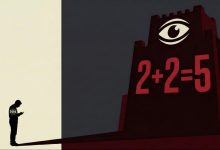
After Reading
A friend once asked me: what struck you most about reading 1984? Many people say fear. But for me, it was something else—a bone-deep sorrow that tears couldn’t wash away.
In that twilight room, he and she wake from their sleep after making love. The evening sun streams through the window, falling across her body. Outside, a washerwoman sings, and the world goes on with its ordinary traffic and bustle. In that moment, their love is undeniable, real beyond question. They both know it won’t last. But the human feelings that have come back to life—he thinks—no one can ever take those away.
Later, in a winter park, she tells him: “I betrayed you.” He says, “I betrayed you too.” She explains: there really are things that frighten you so deeply that you want someone else to suffer in your place, and when you want it, “you meant it.” He nods. As she gets up to leave, her figure disappears into the crowd in an instant. And he wonders: is there anything in this world that cannot be changed?
What does it mean to betray? From the beginning, he told them everything about her. She did the same. Yet after all the torture, he could still face his interrogator and say: “I still didn’t betray her”—because he still loved her. He wasn’t afraid of separation, wasn’t afraid they couldn’t protect each other, wasn’t afraid she might hate him. The only thing he feared was that he himself would stop loving her.
He didn’t believe any force could make him stop loving her—until that force actually appeared.
But really, none of this is about love. For him, love’s deepest meaning was simply this: no matter how they changed him, he could hold onto this one last thing—his conviction, if you want to use a common word. Even after he stopped believing in himself, stopped believing in morality and humanity, he could still believe in his own feelings. When they tore away even this last bit of shelter, he stood completely exposed before the world, ready to be reshaped. No longer a person—just a cold screw in their vast machine.
I don’t know if most people, like me, have lived through two periods of belief in their lives. When I was very young, I believed in the beautiful life and glorious future our textbooks described. Then came that night when my sister and brother-in-law opened a certain book and showed me the raw, bloody truths hidden beneath all the celebration and propaganda. The whitewashed walls around me crumbled piece by piece, no longer able to shield me from the storm. I found myself lost in the world, seeing nothing but blood everywhere I looked.
Much later, I slowly began to believe in something again. But it always came with fear—fear that believing would leave me vulnerable in the same way. My first beliefs were planted in my mind by others when I was too young to resist. Losing them left me confused, but at least I could forgive myself for it. Now, though, I can see clearly. I can raise my hand to defend myself. And yet I’m still building up these beliefs, bit by bit, by my own choice. If one day they too come crashing down, what meaning will my breath, my very existence, have left?
He loved Big Brother.
I don’t know.