After Reading
In Dostoevsky’s masterpiece Crime and Punishment, Raskolnikov, a former law student living in extreme poverty, murders a pawnbroker and her sister. He commits the crime not out of hatred or simple greed, but to test a radical theory: whether certain people possess the right to kill others. After enduring severe psychological torment, he ultimately confesses, accepts legal punishment, and begins a path toward moral rebirth under the influence of Sonya.
After finishing the novel, however, a troubling question arose in my mind:
What if Raskolnikov had escaped both legal punishment and the judgment of his own conscience?
What kind of person would he have become had his theory not collapsed from within?
This question does not require speculation outside the text. In fact, Dostoevsky already provides an answer. Hidden within the novel is an alternative ending for Raskolnikov’s worldview—embodied in another character. In this sense, Crime and Punishment presents not one, but two versions of Raskolnikov.
The Extraordinary Man and the Louse
Raskolnikov does not kill Alyona Ivanovna for revenge or material gain. He kills to test his theory of the “extraordinary man.”
According to this theory, humanity is divided into two categories. The first consists of “extraordinary men”—figures like Newton or Napoleon—who reshape history through decisive action. The second category comprises the overwhelming majority of people, whom Raskolnikov contemptuously labels “lice”: ordinary, insignificant beings whose existence has no independent value.
From this premise, he poses a radical question: Is murder always a crime?
His answer is no. Extraordinary men, he believes, are permitted to transgress moral and legal boundaries when doing so serves a higher historical purpose. History itself seems to confirm this: generals who slaughter thousands in war are celebrated as heroes, while ordinary individuals who kill a single person are condemned as criminals. Law, therefore, restrains only the ordinary. The extraordinary stand above it.
Raskolnikov believes he belongs to this rare category. To prove it—to himself more than anyone else—he murders two defenseless women with an axe.
Yet instead of liberation, the act plunges him into unbearable psychological collapse. Fear, illness, paranoia, and guilt consume him. The law closes in, but even more devastating is the verdict of his own conscience.
At times, he stubbornly insists that he killed “a useless louse.” At other moments, he realizes with horror that what he truly attempted to kill was not a person, but a principle—the principle that he, as an ordinary man, has no right to kill. After the murder, that principle should have died. But it does not. He discovers that killing has not elevated him into the ranks of the extraordinary. He is trapped in between—no longer innocent, yet not transformed.
This is the failure of his theory. Not in logic, but in lived reality.
The Other Raskolnikov
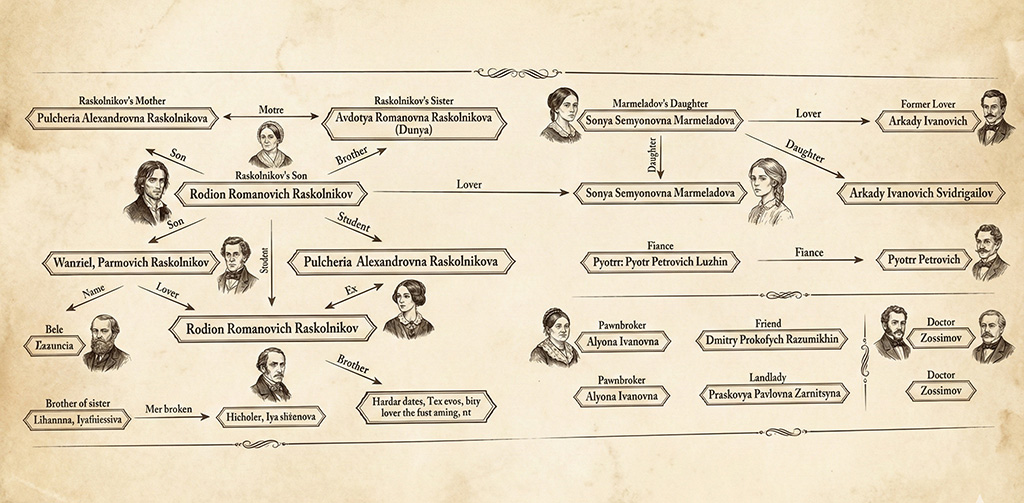
Raskolnikov is twenty-three when he commits his crime. When he meets the fifty-year-old Svidrigailov, the latter remarks:
“I keep feeling there’s something about you that resembles me.”
At this point, Svidrigailov knows nothing of Raskolnikov’s theory or his murders. Yet instinctively, he recognizes a kindred spirit.
Superficially, the two men seem very different.
Raskolnikov is deeply contradictory. Though capable of horrific violence, he repeatedly demonstrates generosity and moral sensitivity. Despite his own poverty, he gives away his last money to Sonya’s family. He vehemently opposes his sister Dunya’s planned marriage to a wealthy but contemptuous man, even though it would secure his own future. He once rushes into a burning building to save children, suffering burns himself.
Svidrigailov, by contrast, is openly corrupt. He freely admits to his debauchery. After a wealthy widow pays his debts and marries him, tolerating his affairs out of love, he repays her by abusing and poisoning her. He sexually assaults his landlady’s fourteen-year-old niece, driving her to suicide. His crimes are numerous, yet he remains untouched by the law due to his wealth—a universal passport that allows him to treat human lives as disposable.
When he reappears in the narrative, it is because he desires Dunya. After overhearing Raskolnikov confess his murders to Sonya, he uses this knowledge to blackmail Dunya, luring her into his room and attempting to force her into submission.
Here, Dostoevsky reveals Svidrigailov’s true function in the novel:
he is what Raskolnikov could become if theory were allowed to mature without resistance.
Love and Redemption: Two Diverging Paths
It may seem strange that someone as thoroughly corrupt as Svidrigailov would choose suicide just as he stands on the verge of continuing his life of wealth and indulgence. The turning point lies in his encounter with Dunya.
Dunya and Sonya belong to the same moral type. Both are strong yet gentle, capable of profound self-sacrifice. Dunya is willing to marry without love to rescue her family from poverty. Sonya becomes a prostitute at eighteen to feed her stepmother’s starving children.
What gives these women redemptive power is not their suffering alone, but their value system—one that stands in absolute opposition to the “extraordinary man” theory:
All human lives possess equal value. No one has the right to kill another.
When Svidrigailov locks Dunya in his room and attempts to rape her, she pulls out a gun and fires two warning shots. At such close range, she could easily kill him.
Instead, she throws the gun away.
This moment shocks Svidrigailov more profoundly than the threat of death. For the first time in his life, he realizes that someone who has every reason to view him as a “louse” refuses to do so. Dunya does not kill him—not because he deserves mercy, but because she cannot reduce another human being to an object, even in self-defense.
In that instant, the worldview by which Svidrigailov has lived collapses. He has always treated others as insignificant, believing himself superior. Now he confronts a terrifying truth: he has been recognized as human—and he cannot bear what that recognition reveals about himself.
That night, he dreams of the young girl he drove to suicide. The next morning, he uses the discarded gun to shoot himself.
Raskolnikov faces a similar challenge when he speaks with Sonya. He asks her to choose between killing a stranger who falsely accuses her—thereby saving her family—or killing her beloved stepmother. To him, the answer is obvious.
Sonya cannot choose.
She breaks down in tears, rejecting not only his conclusion but the logic of the question itself. Like Dunya, she refuses to accept a moral framework in which murder becomes a legitimate solution.
Conclusion
Both Raskolnikov and Svidrigailov embrace the same theory. The difference between them is not intellectual clarity, but emotional capacity.
Raskolnikov’s theory fails because he cannot live with it. He remains capable of love, shame, and being loved. Sonya’s love does not refute his arguments—it exposes their inhuman cost.
Svidrigailov’s theory succeeds. He lives exactly as it demands. And when he is finally treated not as a monster or a louse, but as a human being, he discovers that he can no longer endure himself.
If Raskolnikov had escaped punishment—both legal and moral—he would not have become free. He would have become Svidrigailov.
In presenting these two mirrored paths, Dostoevsky answers the question he never explicitly asks:
a theory that permits murder does not create extraordinary men—it creates survivors who can no longer bear to be human.